Rue de la Roquette is certainly a much quieter street at 6.15am, and it was a good time to be trundling heavy suitcases, without the usual endless flow of people and traffic. We negotiated the metro to Gare du Nord then headed upstairs to stand under the huge, old fashioned Departures board, waiting to see which platform the Amiens train would leave from. We settled ourselves in to a carriage which was roomy and comfortable. It is dark in northern France until after 8am (daylight saving is still in force) so we didn’t see much at first but as the sky lightened we saw rural countryside blanketed in fog. This soon cleared and we were in for a beautiful autumn day, perfect for the start of our 3 day tour of the Western Front Battlefields of World War 1.
Our guide, Peter, met us at Amiens and we gratefully dumped our cases and backpacks into his car. It was a luxury to be driven around and not have to worry about finding our way. Peter lives, eats and breathes World War 1 history and has been a collector of military memorabilia for most of his life. He certainly knows his subject matter and is able to convey it informatively and entertainingly – in other words he is an excellent guide and very personable . We had previously provided the tour company with the name of Ian’s great grand-uncle, Peter Rafferty, who was killed at Pozieres, and Peter has researched him and will trace his story with us tomorrow.
The tour focuses on Australia’s involvement in the war, with today spent in the Somme. Our first stop was the beautiful Adelaide Cemetery, where Peter explained about the incredible work of the Commonwealth War Graves Commission. The final resting places of the thousands of soldiers killed here and elsewhere are given the highest degree of respect. Those who could be identified have a headstone marking their gravesite; the rest are recorded on various memorials to the Missing – these run into the tens of thousands. It was from this cemetery that an unknown Australian soldier was exhumed and taken to the Australian War Memorial in 1993 for reburial.
At the nearby village of Villers-Bretonneux, the French-Australian connection is at its strongest. The small primary school houses a museum with an eclectic range of memorabilia donated by organisations like RSL clubs, and a wonderful collection of black and white photos depicting a more realistic view of the conditions than formal posed shots seen elsewhere. The school courtyard has a large banner saying “Do not forget Australia” and a plaque at the front explaining the link between the two countries. However Peter assured us that contrary to popular belief, the kids do not sing Waltzing Matilda and raise the Australian flag every morning!
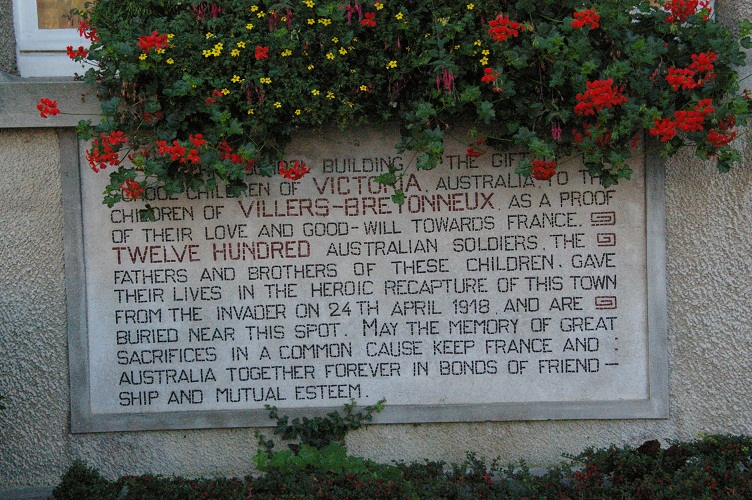
The Australian connection at the school at Villers-Bretonneux
A little further up the road is the National Australian Memorial. A high central tower provides views in all directions for miles, and is flanked by two long walls that hold the names of the 11,000 missing Australian soldiers who died in France – including George Honeysett, another great grand uncle of Ian’s, who was killed by a shell at Poziers and whose body could not be found.

National Australian Memorial at Villers-Bretonneux
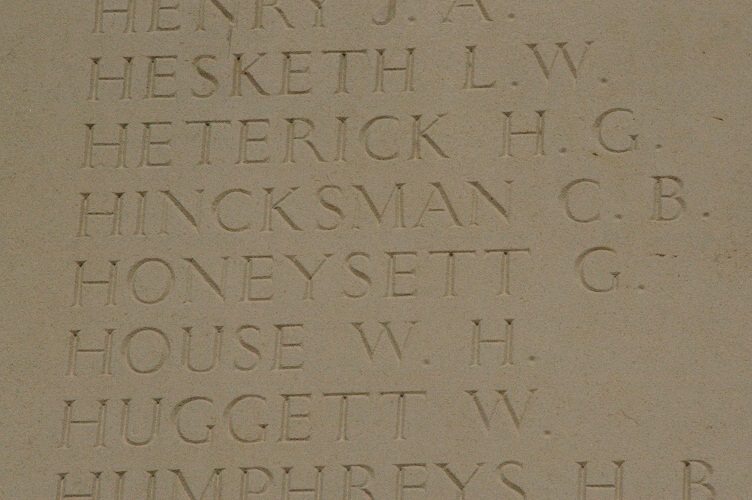
Names of missing Australian soldiers including Ian’s great grand uncle George Honeysett

View from the tower
There are memorials and cemeteries all over the countryside here and we are only seeing the Australian and British ones. We are also getting a glimpse of rural French life as we are well off the motorways. It is very different from Paris, which the rest of France considers to be a separate country!
Our next stop was the Australian Memorial at Le Hamel. This marked the site of the first battle where Australians fought under Australian command. General Monash led a well planned and coordinated tactical battle which was so successful that it became a model for other Western Front action. He planned it to run for 90 minutes; it lasted 93. I wish Melbourne trains could run to such an accurate timetable!
Lunch was at a tearoom run by British expats; there is quite a group of them here, all with the same interest in military history. Peter is lucky enough to be making a living from his hobby. Others are writing books, or conducting archaeological research. There are a growing number of Australians visiting the area as more people do family tree research and discover they have relatives buried or commemorated here.
Our afternoon was spent learning about the British forces, first at La Boiselle, site of a massive crater where several mines were blown with the intent of destroying sections of the German front line. You can still pick up pieces of shrapnel from the field nearby. Next we went to Thiepval where we learned about the beginning of the Battle of the Somme. On one single day, July 1 1916, Britain lost 20,000 men. The towering monument here records the names of the 72,000 British soldiers declared missing in the Somme. The sheer numbers are quite mind numbing. Even today it is possible to find long dead soldiers when fields are dug up to install pipelines or other infrastructure.
Returning to Amiens, we checked in to our hotel which is rather luxurious. The historical part of the town is charming with its many churches, cobbled streets and canals. The Cathedral is twice as large as Notre Dame in Paris! We meandered down to a quayside restaurant for dinner. All in all a most interesting and enjoyable day.
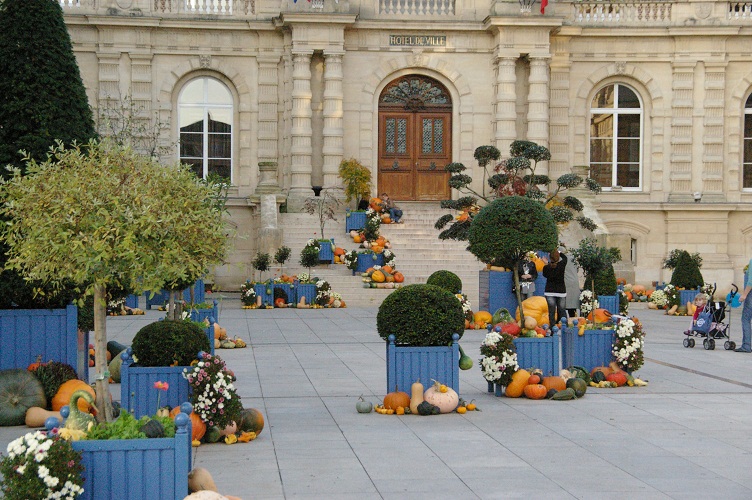
Pumpkins on display in Amiens town square

Amiens Cathedral
 dipidydoo