
Worloy-Baillon Cemetery
A heavy fog had descended on Amiens overnight, and the air was damp with condensation. As we drove higher the blanket lifted to another sunny autumn day. Something I hadn’t thought about was the foliage – we have seen plenty of leaf colour. They are falling rapidly as the temperature is about to plummet later this week, just as we head to Turkey.
Ian had another (somewhat distant) relative in a less well known cemetery at Warloy-Baillon, which is not on the normal itinerary but Peter obliged with a side visit. We located the grave of Peter Maher, who was Ian’s great-grandmother’s brother-in-law. He died in the Somme in April 1918.

Pozieres Cemetery
But the main story today was about Pozieres, and Peter Rafferty, Ian’s great grand uncle on his father’s side. Ian’s father Fred of course never knew his great uncle Peter but he remembered his great uncle Matthew, Peter’s older brother. Both men grew up in Glenpatrick, near Avoca in central Victoria, and they joined up just two weeks into the war, as part of the AIF 8th Battalion. Also from Avoca and in the same battalion was Private R L Yates. Peter was killed in action at Pozieres in July 1916 after the heaviest German bombardment ever seen by Australians. Matthew had seen his brother one or two days beforehand but did not see him die, and Peter was subsequently listed as missing. It was not until 1919, when the long process of restoring Pozieres was just beginning, that Peter’s body was found and he was buried in the cemetery there. The adjacent gravesite was that of R Yates. Immediately noticeable was the close proximity of the two headstones, indicating that the two boys from Avoca had fought and died together. Matthew moved to Bayswater after the war to join his sister Sarah, who later married Henry Dodd.
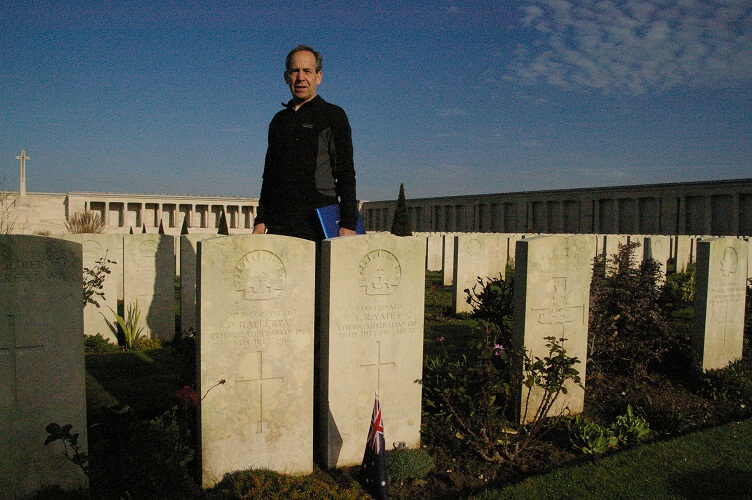
Peter Rafferty and R L Yates – two mates fought, died, and are buried together
From the memorial to the Australian Infantry 1st Division at Pozieres, we could see the surrounding countryside and understand how the fighting unfolded. The Germans had dug themselves in months beforehand, but the Allied forces were gradually able to advance and take their objective, the strategically positioned Pozieres windmill site on a low ridge near the village. This came at an enormous cost of 7000 Australian lives.
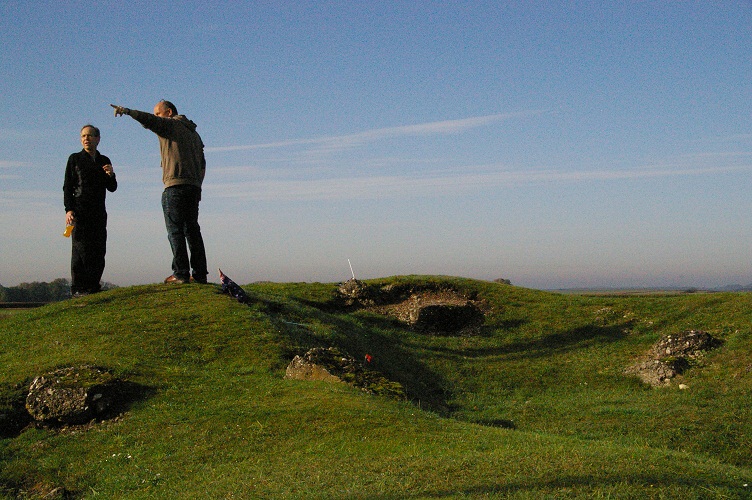
Ian with our guide Peter at the Pozieres Windmill site
After lunch at Bullecourt we visited some poignant memorials – the Slouch Hat, the Digger (which was a very realistic portrayal of an Australian soldier fully kitted out to march), Vimy Ridge, the Canadian memorial; and the Cobber, depicting an Australian soldier rescuing a wounded mate (against orders). We also saw the new cemetery at Fromelles, established after the recent discovery of 250 Australians in a nearby wood. Thanks to DNA testing, 150 of these men have now been identified. We saw the battlefield at VC Corner, where the landscape is completely flat and open. The fighting here was purely diversionary and seems completely pointless, and the Australians were sitting ducks as they came over their low trench wall.
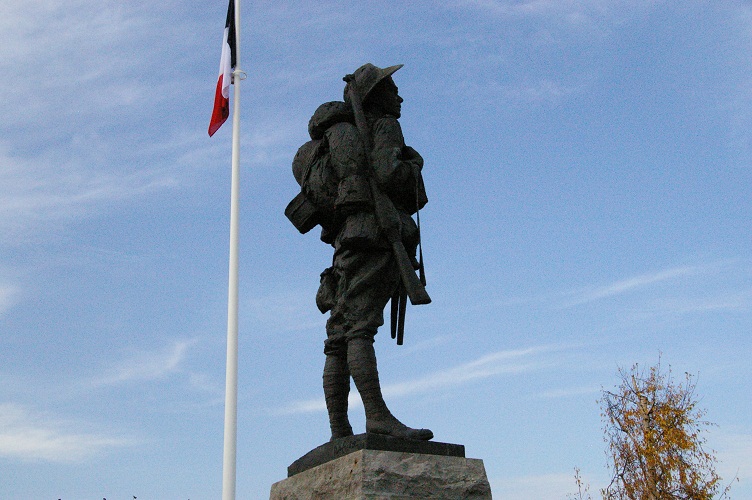
The Digger statue
Our overnight stop was Ypres (aka Iepers, pronounced Eep), so we crossed the unremarkable border into Belgium, home of chocolates and waffles. The French signs have been replaced by Flemish ones. Ypres is a walled city with massive defensive ramparts built in the 1700s. Everything inside the walls was destroyed during the war and rebuilt since. You can walk right around the ramparts high above the river which forms a moat surrounding the town.
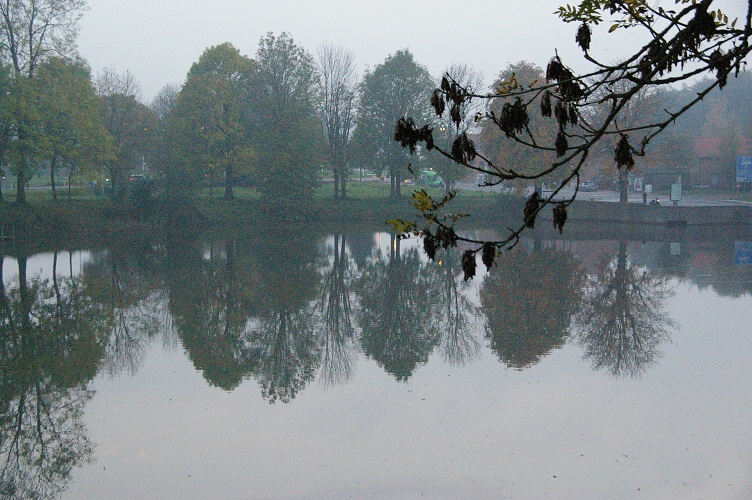
Moat surrounding Ypres
Set into the wall is the famous Menin Gate, an enormous memorial which holds the names of 54,000 missing British and Allied soldiers from the Ypres Salient battlefields. The Australian forces cover 7 of the multitude of panels. Ian has another distant relative, Stanley G Jones, named here, and we managed to locate him on Panel 17.
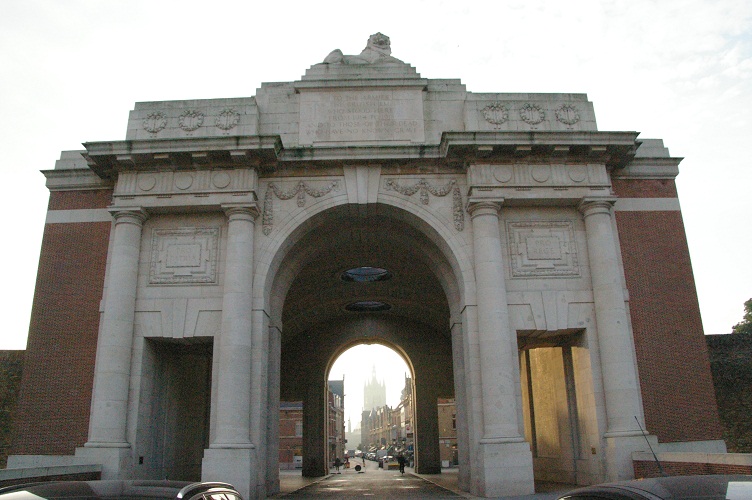
Menin Gate
Since 1928, the Fire Brigade has held a nightly ceremony under the gate, with four buglers playing The Last Post and Reveille. This ceremony goes ahead regardless of the weather, and only stopped during WW2. They started again the day after the German occupation ended. Hundreds of people gather to quietly watch, then disperse into the cobbled streets of the town.
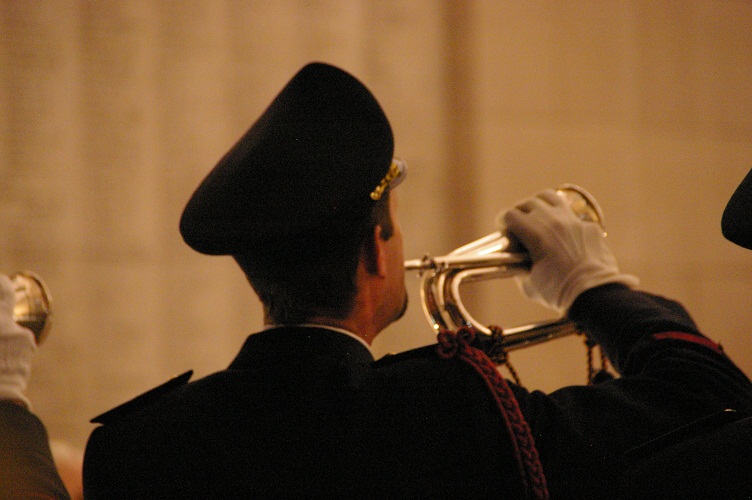
Bugling the Last Post
 dipidydoo