It was Sunday morning, and time for our first ever UK orienteering event. The local club, Newcastle and Tyneside Orienteers (NATO), were staging an urban race in Killingworth, which is an outer suburb of Newcastle. It was very relaxed, with a “choose your own start time and course”. We felt that we’d done our share of orienteering just negotiating the dozens of roundabouts (one of which we did 1.5 laps of before choosing the right exit). We pulled up at a car park beside a small lake, and received a friendly greeting. We were quickly registered and under way. Ian chose Course 2 (5.8 km) and I chose Course 4 (3.7 km) – both courses were actually about 50% longer. It was true urban orienteering with a colour map at 1:5000, and they used Sportident units. Anything that looked like a vaguely busy road was marked out of bounds.
The first half of Ian’s course was mainly long legs, designed to give extra distance and get competitors across to the more complex eastern side of the map. It wasn’t until his 8th control that things got tricky. My course had some nice route choices earlier on, and it certainly had my brain working overtime to decide which tiny lane to go down, or which of the numerous walls to wriggle round. Great fun and certainly blew out the cobwebs.
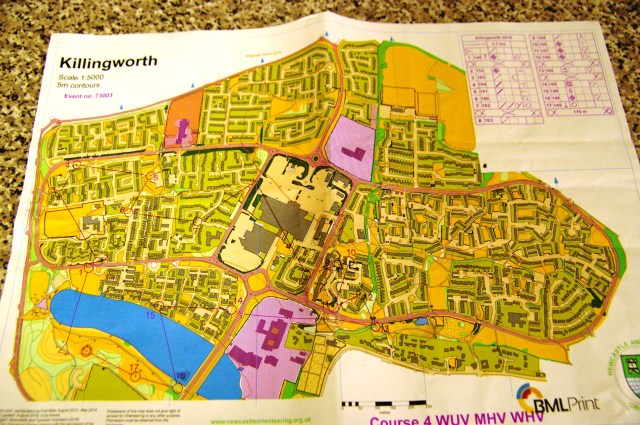
Deb’s course
After stocking up at the enormous supermarket, which contained more GF goodies than you can poke a stick at, we debated how to spend the afternoon. We’d kept options open due to the forecast for heavy rain, but the skies cleared and we agreed to drive north into Dodd Country, aka Northumberland National Park.
We meandered along familiar roads back past the airport, Pontelands and Belsay, then took the road toward Otterburn and Jedburgh (Scotland). We topped a crest as we entered the park, and stopped in our tracks – well we would have if we hadn’t been driving. It was as if the world suddenly opened up before our eyes. We realised we’d been hemmed in by hedges and stone buildings. Now we were seeing a broad panorama of sweeping hills, green and gold in the sunshine, and purple tinged with heather. This was Northumberland, and it was beautiful.

Border country

Wind turbines dot the ridge
We were headed first for Elsdon, and we turned off, driving through what looked like someone’s back yard. We climbed a bit, then descended into “sleepy hollow”. Elsdon is charming and quaint, and looks like a great place for peace and quiet. Most of the houses are set around a central green, with a tea shop and the lovely parish church of St Cuthberts on one side, dating back to 1400. Dodds may have been baptised in this church in the 1800s, although we don’t have recorded proof. We wandered around the graveyard then took a look inside.
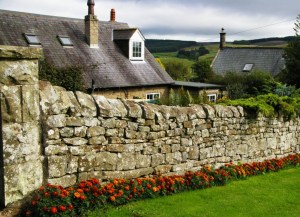
Elsdon houses

St Cuthberts, Elsdon

St Cuthberts interior
Elsdon provides a slice of history from the 1100s onwards. It has a Norman hill fort, site of a former castle, with the earthworks of the motte and bailey still visible. It has a well preserved pele tower from the 1400s, which provided refuge from reiver raids, and was the home of the rectors of St Cuthberts until 1961. It is now privately owned. It also has a village hall, circa 1960, which is completely out of keeping with the rest of the village. Go figure.
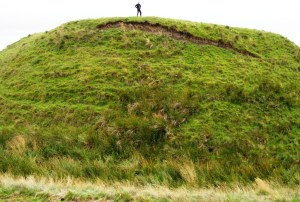
King of the Castle – on top of the Norman hill fort
Next stop was Monkridge Hall and the Gate Cottage, where George Dodd and his parents and some of his siblings lived in 1851. It was probably his last home in England before emigrating to Australia. There were two cottages side by side and we can’t tell whether they lived in the one still standing, or the one now fallen into ruin – but it gave us a great general picture of the general area that the Dodds lived in. The owner of Monkridge Hall (formerly the manor house of the estate) came out when she saw us – probably to make sure we weren’t upsetting the sheep – and had a chat, but she knew nothing about the history of the cottages.
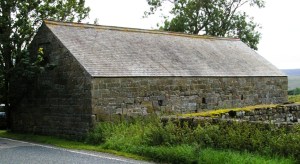
Monkridge Hall gate cottage
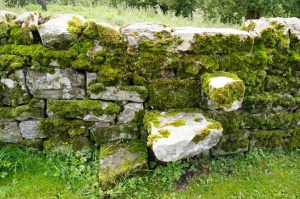
Stone stile over stone wall, Monkridge Hall cottage
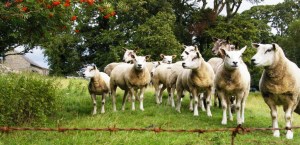
The sheep were pertubed when they heard Ian the Reiver was in the vicinity
On to Otterburn, and then to Rochester; both places where Dodds are recorded as living.

Otterburn’s church
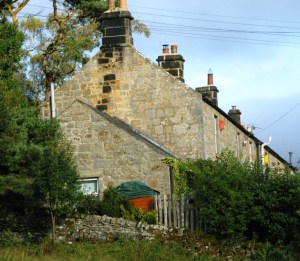
Houses in Rochester
From there, we started climbing again, as we approached the Scottish border. A deer sprang out in front of the car as we drove through a stand of forest; then we were back into the high moorland country again. A Scotch mist was sitting on the hilltops.
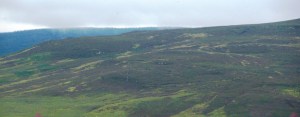
Heathery hills of Northumberland National Park
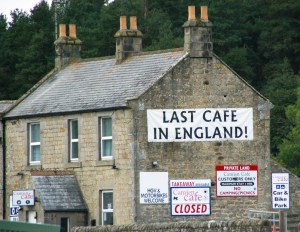
The last cafe in England was not open

English
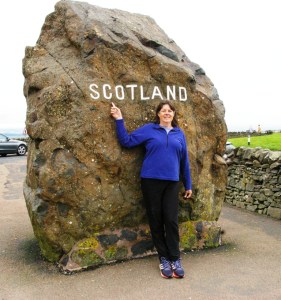
Scottish
We paused at the border for obligatory silly photos, then continued on to Jedburgh, where Sarah Dunn (George Dodd’s mother) came from. There, we had a look at the ruined Abbey, with its graceful arches, from outside.

Jedburgh Abbey

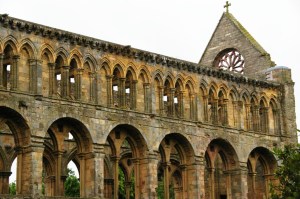

Time Lord?
It was time to turn around and retrace our steps back to England, and home. A wonderful day.
 dipidydoo