After three days of our own version of Escape to the Country, we decided it was time to have a look at the City. Our accommodation host had advised us, wisely, to drive to a Park & Ride and take the metro train, rather than do battle with the traffic and the one way streets.
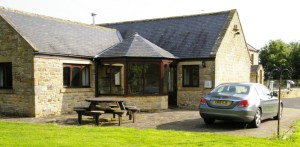
Lord and Lady Dodd are in residence at their country retreat, Toft Hall
We congratulated ourselves on purchasing tickets and catching the train in the right direction, only to be stopped in our tracks at the ticket barrier at Newcastle Central. Apparently we should have bought Zone A & B tickets, but we’d bought Zone B & C. Luckily we sounded pitiful and confused, and the nice station man felt sorry for us and sold us the right tickets, rather than fining us 20 pounds each. Feeling like petty criminals, we hit the streets and headed for the river.
Newcastle is famous for the seven bridges that span the Tyne. Most of them are a short distance apart, and can be seen easily on a short walk. Arguably the most well known is the Millennium Bridge, which was the first tilting bridge in the world. The bridge people get to play with their tilting mechanism daily at noon, regardless of shipping traffic. They sound an official siren to shoo all the pedestrians off, 5 minutes beforehand. Then it all starts creaking and groaning, and the whole thing gradually tips up and sideways. We watched, fascinated, as it reached its 45 degree angle, then slowly returned to normal. It’s one of the coolest things you could see when you’ve got 10 minutes to spare in the middle of the day.
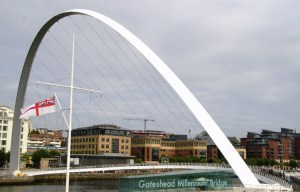
Millennium Bridge
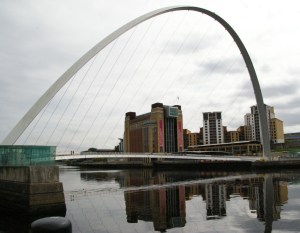
Millennium Bridge with Baltic art gallery in background
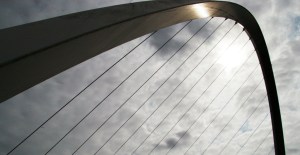
Bridge tilting

Hey Sydney, does your bridge do this?? No, didn’t think so
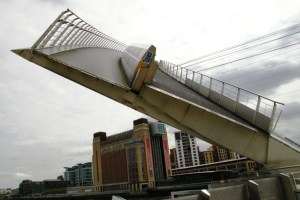
Full tilt
Riverside Newcastle is home to some new galleries and museums, such as the Baltic Centre, and the Sage Gateshead, which looks like a huge shiny armadillo. Crossing the tilt bridge, we had great views back towards four of the other bridges. There’s the Tyne Bridge, aka the “coathanger” which is a smaller version of the Sydney Harbour bridge; the swing bridge, which turns 90 degrees to let ships through; the High Line, which is a rail, road and pedestrian bridge, and the Queen Elizabeth II bridge. The other two are further upriver.
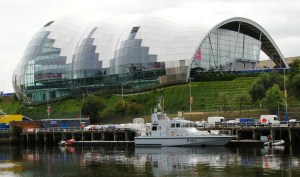
The shiny armadillo, aka Sage Gateshead
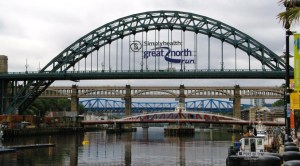
Four of the seven bridges
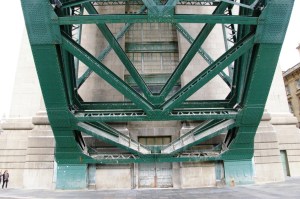
Underneath the Coathanger
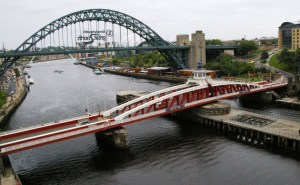
Swing bridge and Tyne bridge
We wandered along the riverbank until we reached the High Line, then climbed high above the water to reach the pedestrian level. This bridge underwent an 8 year renovation recently, after 8000 defects were discovered. It’s like being inside a giant meccano set.
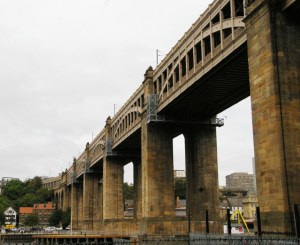
High Line bridge
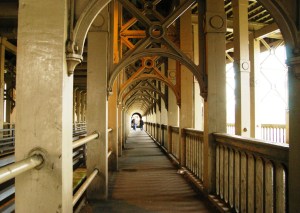
Meccano

The “new castle”
From there we had a quick look at the city’s eponymous castle, medieval walls, and cathedral. It was time for lunch, but we couldn’t find anywhere nice to sit down and have a picnic, so we hopped the train to South Shields. The metro system is small but efficient, and we were happy to nab the two seats right beside the driver, which means you can see out of the front window for a different view of the tracks, tunnels, stations, and oncoming trains. Because we’d bought the “wrong” tickets, we were allowed to take the short ferry ride between South Shields and North Shields.
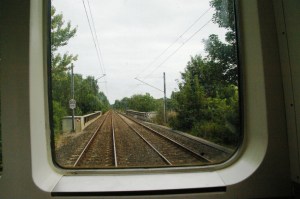
Up with the driver, ridin’ the rails
Having come all this way to the mouth of the Tyne, we decided that we wanted to see the sea, and the breakwaters that form a protective barrier, or Shield, from the worst of the North Sea storms. It was a bit of a hike, but the unmistakeable screech of seagulls and the fresh salty air made it worthwhile.
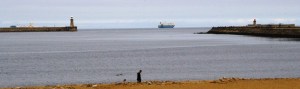
North and South Shields, where river and ocean meet
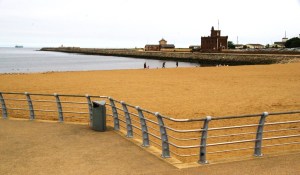
Oh I do love to be beside the seaside
The ferry pilot tried to convince us we were off to Bergen, but just 7 minutes later we were berthing across the river in North Shields. Or were we? It was something of a surprise to find ourselves passing Iceland!
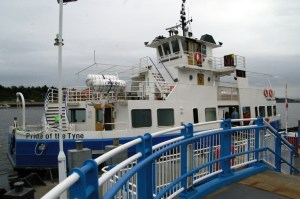
Ferry to Bergen?

No – Iceland
Back on the train, and back in the city, we disembarked at Monument station. I was on an important mission. A walk downhill through the Georgian area brought us back to the cathedral. I ducked down an alley, turned right, and looked up to find my prize – the notorious Vampire Rabbit! It was so exciting to see the real thing. ** Ian did not quite share my enthusiasm. The Vampire Rabbit is 116 years old, and its origin remains a mystery. Who cares? The fact that it exists is good enough for me. Fun fact: it is a Grotesque, rather than a Gargoyle, as it does not spout water.
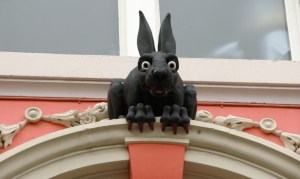
Vampire Rabbit. Tell me that wasnt worth a trip to Europe
Our final stop was the Discovery Museum. This free museum is the temporary home of Stephenson’s Rocket, the famous steam locomotive. It is the first time since 1862 that it has returned to its northern home, as it is usually housed in the Science Museum in London. It’s quite small and unassuming looking, but it certainly changed the way people thought about the capability of railways. The museum had some other interesting displays which occupied us for the remainder of the afternoon, including an Enigma machine, and a very cool 3D map of the River Tyne which showed the railways and docks as they were in 1929.
** Quote of the day: “You made me walk 15 kms just to see a rabbit”.
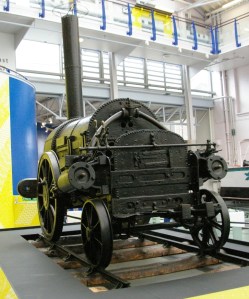
Stephenson’s actual Rocket
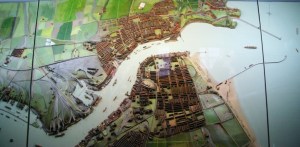
3D map showing the mouth of the Tyne
 dipidydoo