Our first port of call was Lerwick, the capital of the Shetland Islands, and Britain’s most northerly town (if we’d brought DROC jackets we could have claimed the record for the DROC jackets which have been the furthest north within the British Isles). The Shetlands lie 130 miles northeast of the northern tip of Scotland. Lerwick is a protected natural harbour, on the biggest island, which is strangely called Mainland. We’d made up time overnight, despite our departure being four hours late, and we were ready to meet James, our tour guide and local resident born and bred. James runs a farm with his family when he isn’t taking people on tours. He has a keen interest in local history and geography. There were only 8 of us so we were in his small van.
After a short drive through some of Lerwick’s older streets and newer areas – it was a bigger town than we imagined – we started on our tour to the southern end, 25 miles away. We turned off the main road to our first stop, a tiny hamlet called Fladdabister, where we had gorgeous coastal views. James explained that we would generally never be more than three miles from the sea – either the Atlantic Ocean or the North Sea. We also learned that Shetland’s sheep, cattle and ponies are all very stocky with short legs. As there are no trees, they don’t need to be tall to graze. Shetland is on the same parallel, 60 degrees north, as Bergen, and the southern end of Greenland.
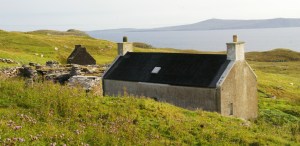
Fladdabister
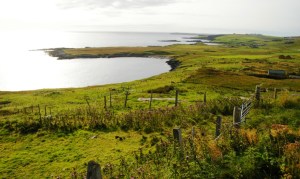

We pressed on through small places whose names were obviously Norse influenced. While Shetland has belonged to Scotland since the 1400s, before that it belonged to Norway, and some of the language has survived in place names and boating terms. The flag is the same blue and white as that of Scotland, but it is a Scandinavian cross rather than the diagonal St Andrews. Links between Shetland and Norway have remained strong through the centuries.
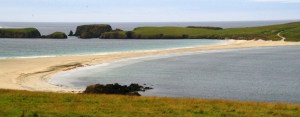
We crossed the island to Bigton, where James lives, to see the beautiful sand causeway that links St Ninian’s Isle to Mainland. St Ninians is famous as the place where a hoard of Viking treasure was discovered in 1958 by a schoolboy, on his first day of his first archaeological dig. At that point I would have quit and bought a Tattslotto ticket.
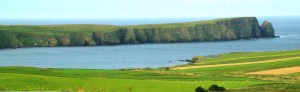
Bigton and St Ninians
Almost at the bottom of the island, we drove across the airport runway; there are traffic lights which indicate when a plane is taking off or landing. The only other airport where this happens is Gibraltar. We made our first extended stop at Jarlshof, a truly remarkable place.
Jarlshof came to light 100 years ago, after storms exposed stonework under a grassy mound. There are six main levels, showing six distinct periods of human occupation of the same site, covering a period of 4000 years! The earliest is a Stone Age hut from approx. 2700 BC. You can still see grinding stones. There is an Iron Age broch and wheelhouses from about 100 AD; a Viking long house from about 800 AD, and a 16th century earl’s house and farm. I have never seen anything like it.
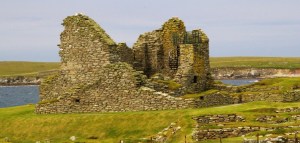
Amazing Jarlshof – 4000 years of history in one place

Viking chess. Harder than it looks
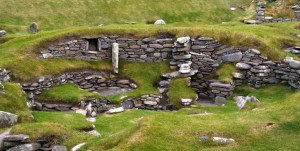
Bronze Age dwellings
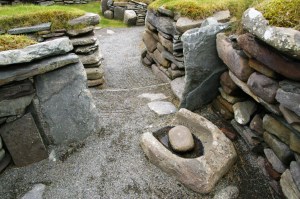
Grinding stone
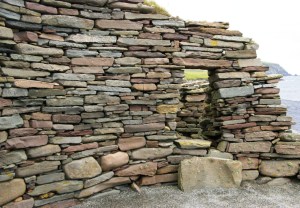
Iron Age broch
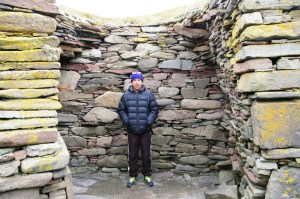

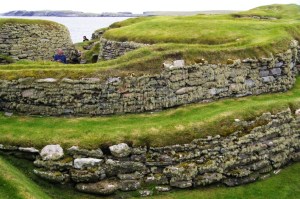

Viking long house
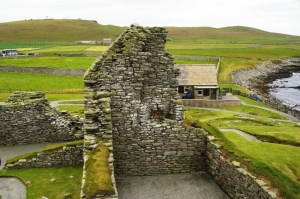
16th century laird’s house
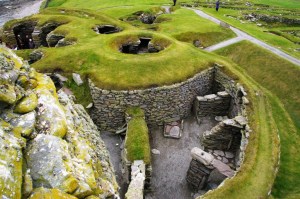
The broch, or roundhouse, was an Iron Age defensive tower, and the carefully constructed dry stone walls are still well above head height. It was surrounded by smaller wheelhouses, which were the family dwellings. These were fascinating structures. It is not known who the inhabitants were defending themselves from. The main Viking building is rectangular, so quite distinct, and would have housed an extended family of about 20 people. The earl’s house was two storey, and stands dominantly above the rest. Great views along the coast can be had from the upper storey. I could have spent several hours poking around here; it was amazing. Ian and I tried to get our heads around a board game known as “viking chess” but it was far more complicated than it looked.
We retraced our route, stopping to meet some miniature Shetland ponies, and pausing to look at an upturned lifeboat which has been converted into a shed. This was notable as being one of the lifeboats frome the ship Oceanic, built by the same White Line that built the Titanic, and wrecked off Foula, a small island about 25 miles west.
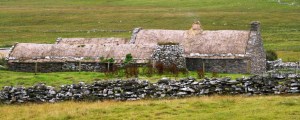
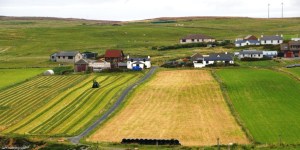
Crofter’s cottage

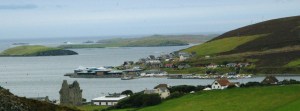
From here we headed across to Scalloway, on the west side of the island. Scalloway is very pretty when seen from the hills above. It is best known for its ruined castle. Not that fancy as castles go, but much grander than the tiny crofting cottages which surrounded it. Its walls were immensely thick. It was built in 1600 by Patrick Stewart, but never used again after his hanging for cruelty in 1615.
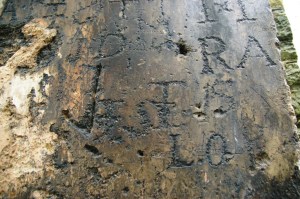
Graffiti from the 1600s, at Scalloway Castle
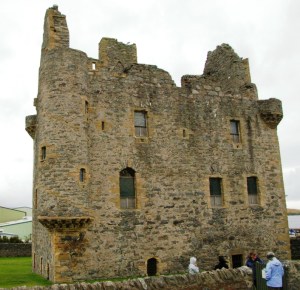
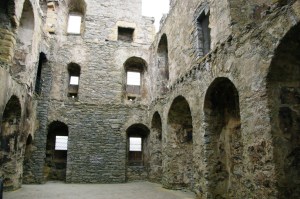
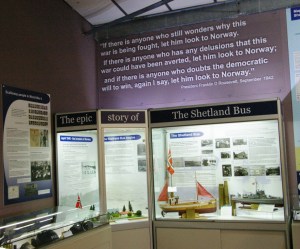
Next door was the little museum, which housed an interesting display on the “Shetland bus”. This little known story from WW2 deserves more attention. The Shetland Bus was in fact a fleet of fishing boats, used to smuggle agents in and out of Norway, from Scalloway. The locals all kept the whole thing secret; not even nearby Lerwick knew about it. It was also used to bring refugees out of Norway. Many boats and lives were lost, but many were saved, and some of the individual stories were told. There is a memorial beside the sea, and an annual commemoration; this has further strengthened their bonds with Norway.
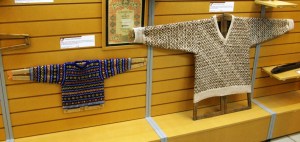
For the knitters
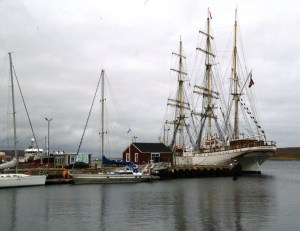
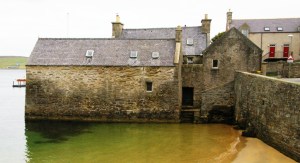
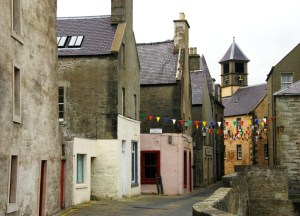
Finally James showed us the picturesque Tingwall valley, where the ancient Parliament used to meet in Norse tradition. We could see purple heather blanketing the slopes, and peat cuttings, reminding us we were in Scotland. We returned to Lerwick for a stroll along the tiny lanes, a look at a 3-masted Norwegian tall ship, and some Shetland fudge shopping, before returning to the ship. It was a most enjoyable day.
 dipidydoo