Our day in Belfast turned out to be quite eventful. It began with a bus ride into town from the ship, which was docked some distance away. We’d decided to take the Hop On Hop Off (or HoHo) bus, which would give us a good overview with commentary, and allow us to alight at places worth further exploration. The round trip was about 90 minutes. We decided to do a full lap first, then go around again and get off at whatever took our fancy.
After making us wait in a queue, the Visit Belfast office sent us to an entirely different ticket office around the corner. That office sold us tickets, but gave us completely wrong directions for the bus pickup point. After rushing round in frustrated circles, we finally boarded the distinctive red double decker bus, heading upstairs and scoring front row seats. A lot of today’s photos are taken from here, so please forgive a bit of window glare and odd angles!
After crossing the river, we drove past the Titanic Museum (no 1 visitor attraction in Belfast, if not the world – we decided it would be too crowded), the shipyards, and the giant TV studios where “Game of Thrones” is filmed (no sign of Jon Snow or dragons, but we can tell you that in season 8, a castle burns down). We also saw the massive pair of yellow cranes known as Samson and Goliath, standing tall and proud over the now empty shipyards where of course the Titanic was constructed.
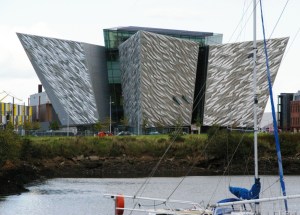
Titanic Museum
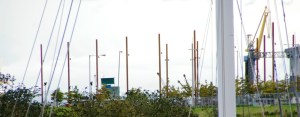
Slipyards
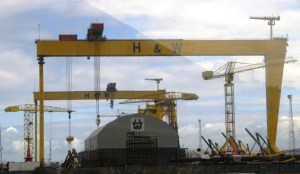
Samson and Goliath

Game of Thrones TV studio (one for the fans)
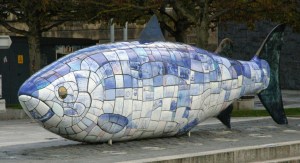
A Big Fish
From here it was out to the leafy eastern suburb of Stormont, where the grand Parliament House is located. It’s a surprising distance from the centre of town, maybe with good reason. We learned that Northern Ireland has not had a functioning Parliament since late 2017 (and they seem to be managing fine without it – just sayin’). This is an affluent area with million-dollar houses.
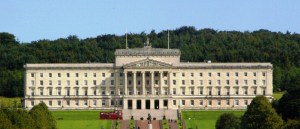
Parliament getting along just fine without anyone running it
We drove down Belmont Road, a strongly Protestant area where Union Jacks are displayed everywhere to show support for Queen and Country. This was our first chance to see the famous murals. We looped back towards the city centre, then south again past the University, where students were arriving for orientation.
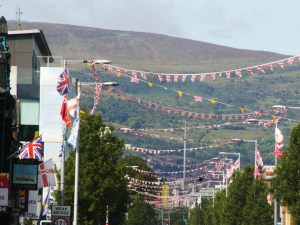
Unionist East Belfast

No relation
The next section of the tour took us to the notorious Falls and Shankill Roads, names known worldwide to anyone who, like us, grew up during the era of the “Troubles”. For 30 years, Belfast was subject to shootings, bombings, and acts of terror, as the Catholics and Protestants disagreed violently about how they were governed. Quick refresher – the Catholics support Northern Ireland becoming a free state, while the Protestants want to remain under British rule. Religion has very little to do with it – it’s all about politics. Peace was finally brokered on Good Friday in 1998, and Belfast began to rebuild itself.
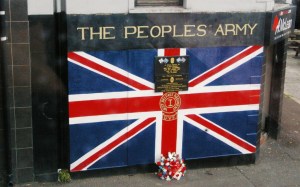
We saw many murals from the bus, as well as the Peace Walls, poppy crosses and commemorative gardens. We had no idea that Belfast was still so physically divided, and we were starting to realise that there were several aspects to this that warranted a closer look.
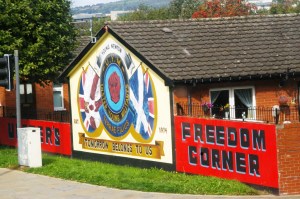
Freedom Corner
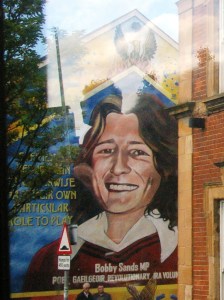
Bobby Sands mural
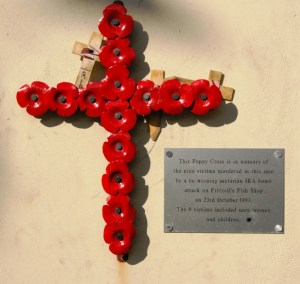
Poppy cross, Shankill Road
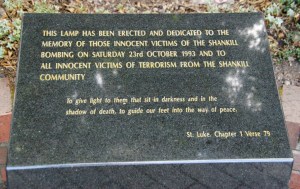
Memorial garden
After passing Crumlin Road jail, the bus returned to its starting point. We headed to nearby Victoria Square shopping centre, for its observation dome. Our guide had pointed out that until the troubles ended, no-one built anything from glass. This centre was symbolic of the new modern, vibrant Belfast.
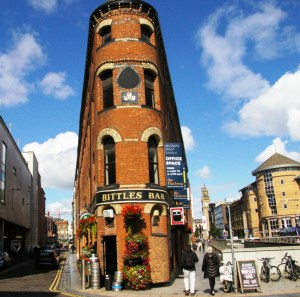
Belfast city centre

New shopping centre
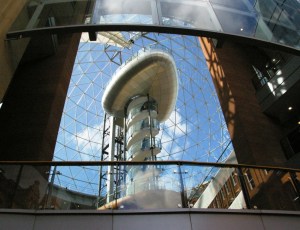
We went to the pod for the view
It was time for lunch, and we had a Plan. I’d found a café online with a completely GF menu, very close by. What could go wrong? As we neared the intersection, we noticed a large building which was now just a burnt out shell. The fire happened only a week ago. Surrounding businesses had been forced to close – including, of course, our café. With no Plan B, we resigned ourselves to another day of eating “lunch” when we reboarded the ship later in the evening.
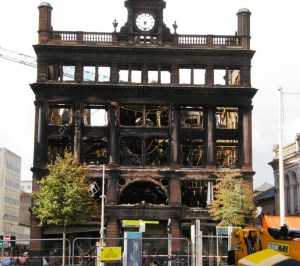
This building burnt down and ruined our lunch plans
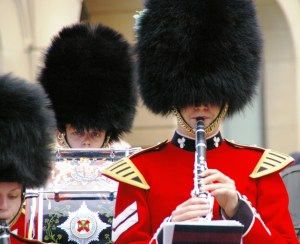
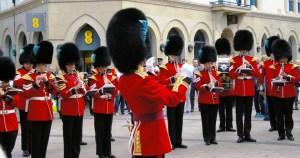
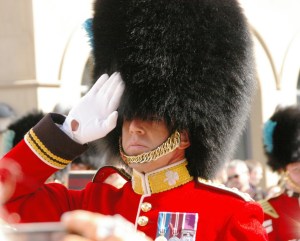
As we made our way back to the bus departure point to begin Lap 2, we noticed a brass band, decked out in bright red jackets, and large busby hats. They were moving purposefully towards a square, where they stopped and arranged themselves in formation. To our delight, they started to play. We were treated to a wonderful rendition of half a dozen stirring tunes. There was a neat salute given by the conductor between each piece. I pointed out to Ian that, had our café been open, we would have missed the whole performance. Every cloud has a silver lining; I was more than happy to forgo lunch for this treat.
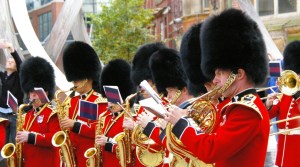
But we got to see (and hear) this instead
We reboarded the bus, with plans to take a walk through the areas where the murals were, figuring they would reveal something of the contradictions in Belfast. The first area we looked at was Freedom Corner, in east Belfast. We realised there are several different types of murals. Some are positive and forward-looking, encouraging communities to work together and to see a bright future. Some are commemorative, marking the violence that marred those 30 years. And some are very political, continuing to make mileage out of past tragedies, and using them as propaganda for any cause or issue.

An optimistic message
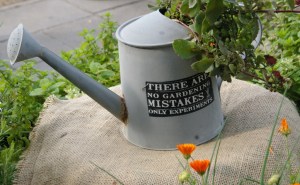
Spotted in a community garden
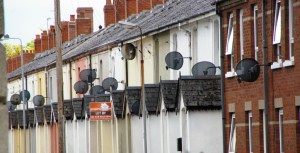
Row houses where shipyard workers lived
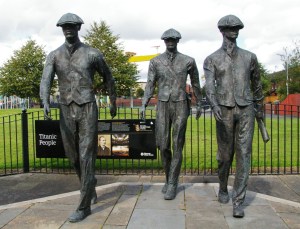
The Yardmen; a tribute to the shipyard workers
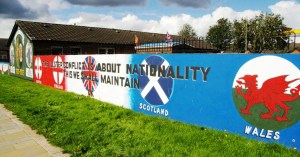
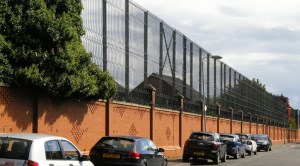
Divisions
We took the next bus to Shankill Road, and got off again to see the larger stretch of murals. The Falls and Shankill Roads are right next to each other, but a world apart. We had already learned, to our surprise, that education is still mostly segregated, and that Catholics and Protestants don’t go to the same shops or pubs. It goes further than that. Many Catholics still live on the Falls Road, behind several miles of wire-topped “peace walls”, and gates that are closed at 7pm each night. The Unionists of Shankill Road, a stone’s throw away, prefer things separated as well. A recent poll of residents on both sides voted to keep the walls in place, despite the government pledging to pull them down by 2023.

The peace wall; no cause omitted
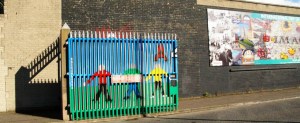
Peace gates. Closed 7pm nightly

Ironic
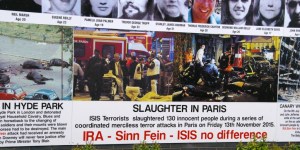
Feelings still run strong here


These men are dead, hence their faces are depicted
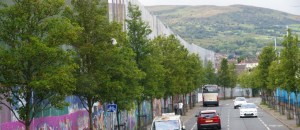
Peace wall, Shankill. Catholics on the left, Protestants on the right
I always assumed the murals and monuments were retained for their historical significance alone, but these are still raw and real. The language on some of them is incendiary to say the least, and in these politically correct times, it is a wonder they are allowed to keep them. It seems that every social or sports club is a vehicle for extremist views. Clearly, it is going to take decades for people to forgive and forget, despite the efforts of those who are ready to move on. Yet it is very safe in Belfast. You can walk or drive freely through the gates, and take photos; no-one takes any notice. The whole experience was quite eye-opening, very interesting and unexpected.
Back in the city centre, we walked across the river, hoping for a closer look at the Titanic Quarter, but didn’t see anything much that we hadn’t already seen from the bus. I caught an earlier shuttle bus back to the ship; Ian followed about 30 minutes later – except that his bus driver had a slight altercation with a bollard! A replacement bus was duly arranged. We finished the day on deck, watching the evening sun cast shadows across Samson and Goliath.

Sculpture representing working together; affectionately known as The Balls By The Falls
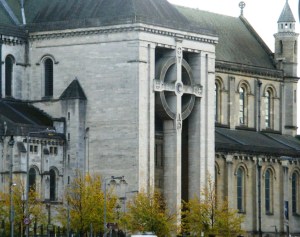
St Anne’s Cathedral
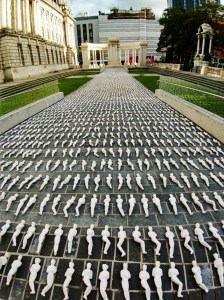
Shrouds of the Somme exhibition at City Hall, representing those who died at the Somme and have no known grave
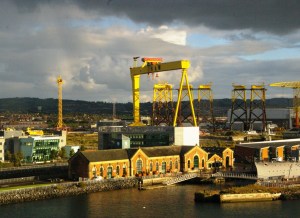
Late afternoon sunshine
We really liked Belfast. It’s a small city, neat and clean, progressive, and proud of its achievements since the Troubles ended. It’s easy to get around, has lots to see, and has a nice sense of humour and a relaxed feel. It’s somewhere I would happily spend more time. It will be interesting to see what happens in coming years. Hopefully a not-too-far-in-the-future generation will take down some walls and start letting go of recent history.
 dipidydoo