Overnight we left the UK and sailed for Ireland, so we ditched our pounds and replaced them with euros. The morning dawned fine and sunny, so it was off the ship and in to Dublin Town. We walked along the north bank of the Liffey, looking at the numerous bridges. I have never seen a river with so many of them. We also saw plenty of new glass and steel buildings around the rapidly developing Docklands area, including one that formed a rather incongruous backdrop for the Famine sculpture.
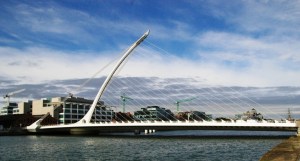
Samuel Beckett bridge
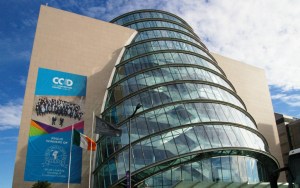
A glass keg?
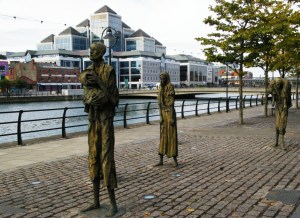
Famine and wealth
Eventually we reached the city centre, where we boarded another HoHo bus – having enjoyed the one in Belfast, we thought we’d do the same thing in Dublin. We soon discovered that the traffic in Dublin is much worse than in Belfast, and there are far too many sightseeing buses following each other like sheep. We spent a lot of time at a standstill, or driving in traffic-induced circles. The commentary was not as good, and unlike Belfast, the bus did not slow down to allow us to take photos as easily. Nevertheless it covered a lot of the main sights and was a convenient way to reach some that were further away.
First we visited the Georgian area, with its elegant buildings and parks. Next was Trinity College, which we planned to come back to later. The Guinness factory and storehouse, covering 64 acres, was a popular stop for many, but we stayed on board. Further out, the bus pulled in at Glasnevin Cemetery. We hadn’t planned to alight there but it looked interesting so we made it a hop off stop. This is the burial site of many famous people, the most notable being Michael Collins. It is a very full cemetery, with many graves and monuments packed in close together, and it was interesting to see the Celtic crosses and read the Irish inscriptions. There is also a memorial wall for victims of the 1916 Easter uprising.
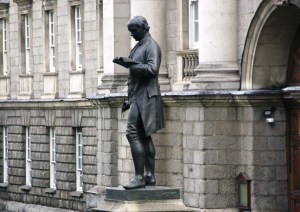
Trinity College
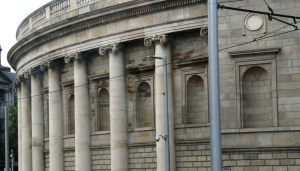
Georgian splendour
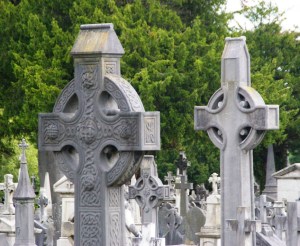
Glasnevin Cemetery


We changed onto the Red bus route to get to Trinity College, which was full of freshman students all signing up to various clubs. The Dublin University Orienteers had a table, but the girl manning it wasn’t exactly run off her feet. We said a quick hello, and continued to the old Library. Trinity College is Ireland’s oldest University, and produced literary greats such as Jonathon Swift, Oscar Wilde, Samuel Beckett and Bram Stoker.

Not the most popular club
The Book of Kells and the library’s Long Room were on my must-do list, but Ian decided to reboard the bus and see some other things. Inside, there was an excellent display about the ancient Irish texts, dating back to the 9th century and so painstakingly produced by medieval monks. This explained the materials used to produce the illuminated manuscripts, and showed elaborate details of some of the pages. After absorbing this in fascination, I went into the darkened room where two volumes of the actual Book of Kells are displayed in a large glass case – no photos allowed. We all jostled for position, and I stared at the ancient pages for as long as possible. I could not believe I was seeing something so unique.
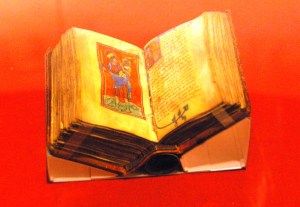
Illuminated manuscript

Detail from the Book of Kells
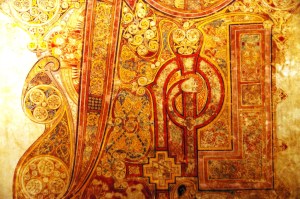
Beautiful
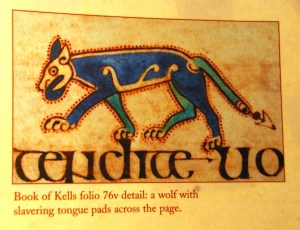
A wolf with slavering tongue pads across the page
A staircase led upwards from this room. As I rounded the corner and looked up, I stopped dead in my tracks. Rising above me was the incredible timbered roof, and the towering stacks of leather bound books, occupying the full length of the room. It was an OMG moment, and it took me a while to start to move. You could inhale the smell of these volumes, all lined up neatly, and with ladders to reach the top shelves. I gradually made my way along the length of the room, spellbound. I never wanted to leave.
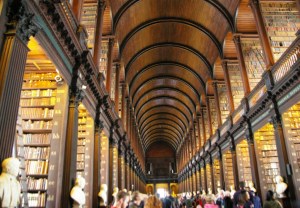
This is where I live now
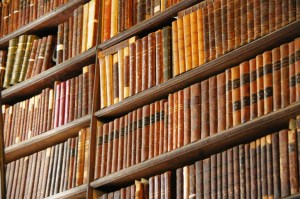
Books. Inhale.
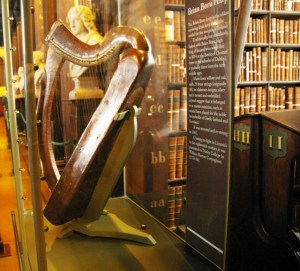
Brian Boru harp. A thing of wonder

An actual Nobel Prize
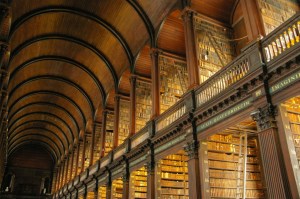
Glorious
In the centre were numerous display cases, including an actual Nobel Prize certificate and medal. Most beautiful of all was the Brian Boru harp, an ancient musical instrument and the symbol of Ireland, which has been caressed so much, the timber is worn to a gleaming patina. The Trinity College Library is a genuine treasure trove. If you are ever in Ireland, make sure you go to Dublin for this. However, I wouldn’t come here to see the Liffey. It’s not a pretty river.
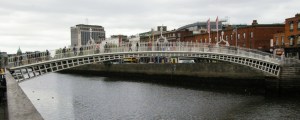
Bridge over the not so pleasant Liffey
Dragging myself away, I walked along very crowded narrow streets, past the famous Molly Malone statue, and on to the lovely Christ Church cathedral. From there it was quite a long trek back to O’Connell Street. Deciding I needed some public transport, I took the Luas tram to Docklands, and back to the ship.
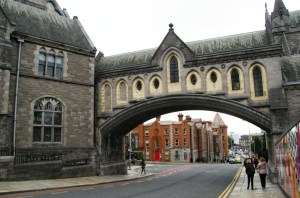
Christ Church cathedral
All in all it was a pleasant day in Dublin, with Trinity College easily the standout. Overall we both preferred Belfast – less crowded, and more to see of interest.
 dipidydoo