We bid farewell to Chatham, after a stay of about 24 hours. Relieved that the long walk to the station was mostly downhill this time, we boarded a high speed train to London. Thirty minutes later we arrived at the huge Stratford International station, built for the 2012 Olympics and adjacent to the new Olympic Park. From here, many new lines radiate in all directions, particularly to the big growth areas. We wanted to see the changes in London in the 21 years since we were last here, and this is certainly one of them.
It was another long hike from here to Daintry Way, but it gave us a chance to have a look at our new environment, Hackney Wick. Lying between Hackney proper and Stratford, but disconnected from both by 1970s infrastructure projects, Hackney Wick was a heavily industrialised, working class area from its beginnings until recently. Heavily bombed in WW2, and generally ignored by planners in the years since, artists started to move here in the early 2000s, as rents became too high in other east London locations. This began the regeneration of the area.
The redevelopment of the Olympic site brought new planning controls, cleanup and rehabilitation – expedited by the enforced deadline. Hackney Wick was situated on the “Olympic fringe”, and investment was more focused on Stratford. Attempts have been made to strike a balance between gentrification and preservation, which has become something of a local political issue. All this has led to soaring property values and rents, and the artists that moved in two decades ago, are starting to leave again. These days it is still going through a transition phase, with trendy vegan cafes, microbreweries and street art, dilapidated houseboats lining the canals, converted factories, and lots of high rise going up everywhere. On a Tuesday morning though, there was hardly any traffic, and few signs of life. We wondered where all the hipsters were hiding.
Daintry Way is part of the Trowbridge Estate on the northern edge of Hackney Wick. It would make a great sprint map! It took us a little while to figure out the location of our upper floor flat. The Trowbridge Estate previously featured 7 high rise towers, which were demolished in the 1990s and replaced by the present low rise “village” style housing. We duly settled ourselves in our flat, which is very modest and needs a little TLC, but is also very functional, and quiet, facing onto a grassy courtyard. Our only excursion today was to the nearest (2 kms away) Tesco supermarket, which gave us a look at neighbouring Homerton.
We surfaced late next morning, and began our tour of Ian’s family history sites – the main reason for selecting our East End location. He has identified a dozen significant addresses to visit. We will leave the details to a separate blog entry, where we can tie it all together; suffice to say we ventured onto the Tube, armed with our Oyster cards, which no self respecting London tourist should be without. These are our passports to the trains and buses, without which you can’t go far here. We went to Stamford Hill, then Shacklewell Lane, and were able to see houses and parts of neighbourhoods much as they would have been 100 years ago.
As we returned to Hackney Central station, we noticed that the overground railway line had dozens of bricked arches; and that these arches were home to numerous small businesses – mostly car mechanics. Intrigued, we looked into it online. We discovered that just 3 days ago, National Rail announced the sale of over 5000 of these arches to a private equity firm for a reported 1.5 billion pounds – that’s an average of 272,000 pounds, or a staggering half a million aussie dollars, per arch! There has been a furore, as rents are expected to soar. Some of the arches have had large amounts of money spent prettying them up. These ones had not. Cheap rents had allowed these small businesses to remain in the city, and they suit “dirty” trades who can’t set themselves up near offices or flats. Another example of the East End’s battle of progress versus preservation.
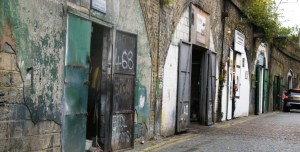
Car mechanic businesses operating from the railway arches of Hackney
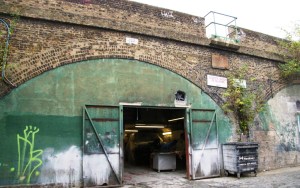
How much will the rent increase after the selloff?
We went for a wander along some of Hackney Wick’s canals. Most of the houseboats have not moved anywhere for years. Rusted bicycles and pots of home grown tomatoes rest on top of them. In the background, construction continues unabated. A street/graffiti artist admires his work with a spray can. The canals are not at all pretty, and we didn’t linger for too long. Hackney Wick is a place that doesn’t know what it wants to be. We’d still seen very few people around – a far cry from the crowds who flock to the organic cafes of inner northern Melbourne. It would be interesting to return in 10 years’ time and see what it has made of itself.
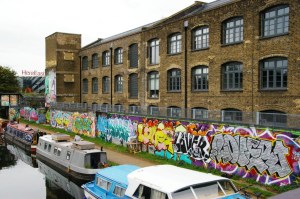
Typical Hackney Wick canals

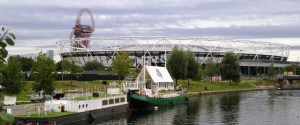
Canal beside the Olympic Park
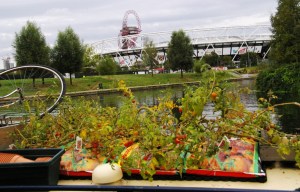
Growing your own vegies
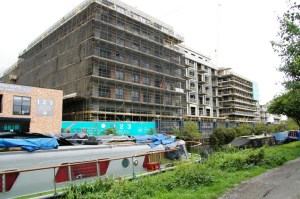
Progress vs preservation

Street art? Graffiti? We think the latter
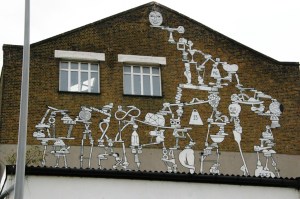
Street art vs graffiti? This one is the former
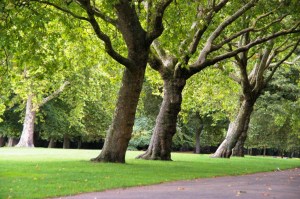
Leafy green Victoria Park, on the edge of Hackney Wick
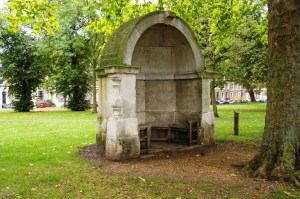
A stone alcove from London Bridge
Hackney Wick station is less than 10 minutes walk away, and we can be in the heart of London in about 40 minutes from our door. We went to see “Bat Out of Hell The Musical” – being Meatloaf fans, we thoroughly enjoyed it (especially as we paid less than $30 each for the seats – you can’t do that in Melbourne!)
 dipidydoo