Today was a visit to another place that’s long been on our list – Berchtesgaden, just across the border in southern Germany. It was a scenic drive hugging the shore of the Wolfgangsee, then onto the freeway to skirt around Salzburg. Past the border sign welcoming us to Germany, then 10 kms along a river valley and into Berchtesgaden.
We had two tours pre-booked. First up was a visit to the salt mine. Great fun! We got to dress up in overalls, though they stopped short of giving us picks and shovels. Next we boarded a mini train, which took us deep inside the Salzberg, or Salt Mountain. Now for the highlight – down the slide! We rode tandem down the polished wooden rail, legs up, lean back, a bit of a “Whoo Hoo!” and you were at the bottom before you knew it. Then a walk to see various displays and learn about salt mining – quite a process apparently. Whoosh down another slide, then a short boat glide across a mirrored lake with water so clear it reflected everything perfectly. As if that wasn’t enough, we rode a steep funicular back up – beats taking the stairs! Then back on the train to exit. Not sure how much we learned about salt mining, but we had a lot of fun.
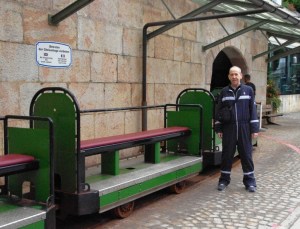
Miner about to commute to work
Back at the car, we had two hours to fill in before our second tour. No problem – we spent it trying to find somewhere to park in town. Berchtesgaden had been quiet when we arrived at 9am, but by lunchtime it was bursting at the seams. The helpful tourist office lady pointed us in the direction of a little-known car park behind the railway station, where you could leave your car all day for a mere €1.50. It took us three attempts to find it, but eventually we did.
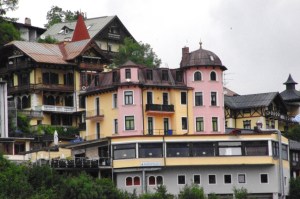
Berchtesgaden old town
We joined our coach with Eagles Nest Historic Tours, a company highly recommended on various review sites – and for good reason. It was excellent. Our guide, Jean-Marc, was a young American of German parentage, who has spent the last three summers leading these tours. He studied history and political science at college, so was well positioned to explain the connection to Hitler and the Nazi Party that Berchtesgaden is infamous for. The Fuhrer loved the area, and spent a lot of time here between 1933 and 1945. He rented a house on the Obersalzberg mountainside, which he eventually bought. His cronies began visiting and spending time here as well, and more and more properties were forcibly purchased from the farmers who owned them. At one stage, Obersalzberg was the second seat of Nazi power, and there was even talk of relocating the headquarters here. Hitler received many visitors and used it as propaganda, promulgating the appearance of being an ordinary, approachable German citizen.
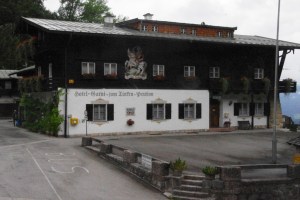
One of the few remaining original properties on Obersalzberg
We were shown various sites with connections to Hitler, including the site of his house (long since demolished and buried under rubble), and the houses of others of his inner circle; as well as the SS barracks. At the Documentation Centre, we were shown through some of the extensive bunkers underneath. Here we saw the air raid shelter which kept its occupants, including Goerring, safe during the bombing of April 25 1945, which was the point at which the Nazis realised the war was lost. By early May, the Allies had taken over, and we saw graffiti to this effect carved into one of the bunker walls.
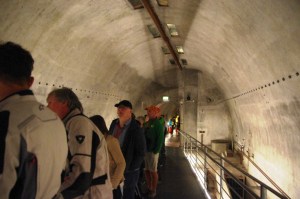
Inside the bunkers
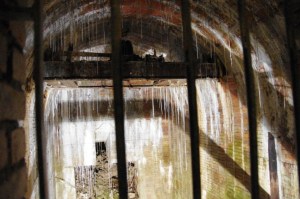
Stalactites in the bunker
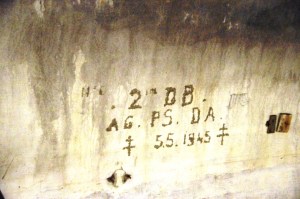
The Allies have arrived
The Eagles Nest was built as a kind of day resort at the top of the mountain – somewhere that Hitler and his buddies could visit and host meetings, but not intended for overnight stays. It is a restaurant these days, but quite a lot of the original building and interiors can be seen – and the views are spectacular.

We’re going way up there
Getting there is quite the journey. From the Documentation Centre, you take one of the red buses, which travel up and down the single lane mountain road in convoys. It’s five miles of narrow winding road punctuated by tunnels and hairpin bends.
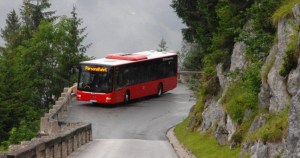
First you need the red bus
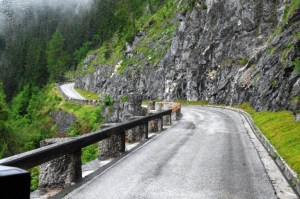
The bus drives up this road
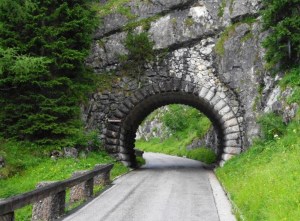
Through five tunnels

Scenery en route
Once at the top, you enter a long, marble lined tunnel which takes you inside the mountain; then into the most elaborate lift I’ve ever seen, to be carried swiftly and smoothly up to the Eagles Nest perched way above. Walking through the restaurant, you see the original wood panelled walls and ceilings, and the fireplace with marble donated by Mussolini. Rumour has it that Eagles Nest was built as a gift for Hitler, but he hated heights and only visited it 14 times. His mistress, Eva Braun, spent much more time here.
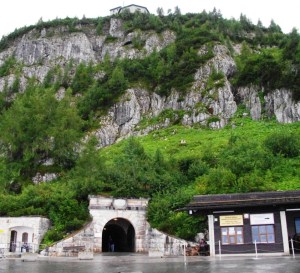
The bus drops you here at the entrance
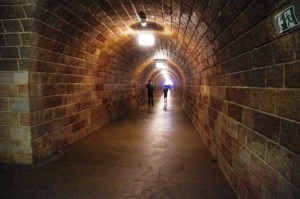
You walk down this marble tunnel to the lift

Original fireplace – marble courtesy of Mussolini
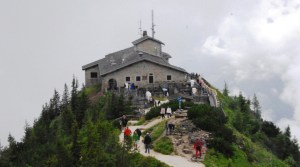
Next you step out on to the sun terrace, then onto a gravel, stepped path up to the lookout at the top. From there you have wonderful views of the sheer peaks and the valleys far below, as well as of the Eagles Nest. Then it’s back into the bus for the return trip – unless you choose to walk (about 2 hours), or plummet down on a bike.
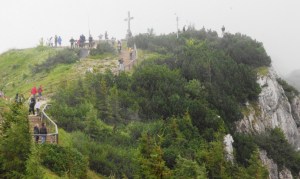
Take the trail to the top

Turn around
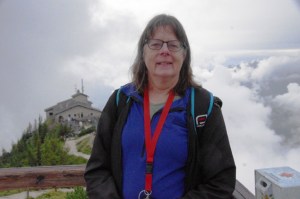
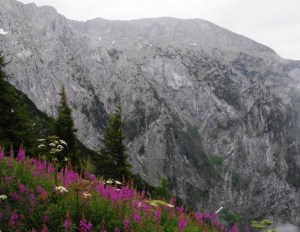
Admire the view
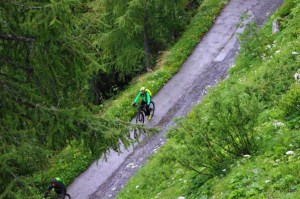
Optional descent
Having been to Berlin, Munich and Nuremberg, this was a look at another part of WW2 history, and a different insight into Hitler’s bizarre and deluded world. At Obersalzberg he was able to escape the reality of the atrocities he’d ordered and which were carried out all too keenly by his henchmen. I was glad it was cloudy and sombre – it suited the subject matter. Sunshine and blue skies would have been incongruously wrong for this appalling part of history.
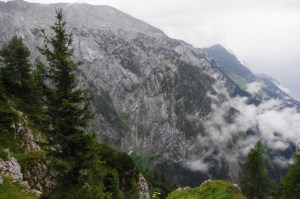
Suitably gloomy
 dipidydoo