It was just a short hop to Regensburg for the fourth race, as we resumed our orienteering program. We had a 900 metre walk to the start. Normally this is a chore, but today we headed off through wooded parkland beside the river, then past colourful houses, a fountain in a platz, under an arch, and out onto the Steinbrucke – the famous stone bridge of Regensburg. This was an iconic place to start if ever there was one. We were surrounded by history, and the twin spires of the cathedral could be seen across the river.
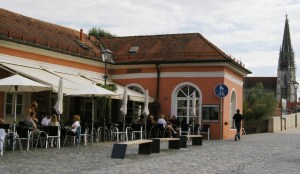
We started here
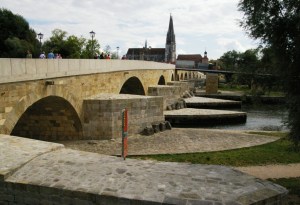
And ran over this

Then under this
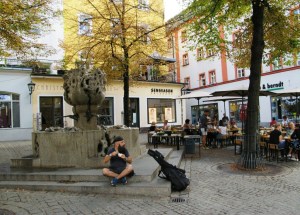
To get to here
I hadn’t tested my ankle yet, but I was determined to run at least a bit of the course. Our first leg was straight over the bridge, giving plenty of time for route planning. I broke into a shuffle, then a jog. Surprisingly, there was no pain in the foot – just a slight twinge every so often. I decided to keep running for as long as it would let me. Down the bridge, under a large gateway, turn left onto a busy street – watch the pedestrians, cyclists, cars and buses! First control just around the corner – almost overshoot. Control 2 is in a courtyard but easily accessible, no problem. Control 3 is a very short distance away – but wait – is that a black line blocking my forward progress? Yes it is – turn tail and run the long way round (this leg was later voided, as there was no actual barrier where the map showed one, and a lot of people ran straight through).
In Melbourne, your self talk goes something like this: “cross the road at an angle, then take the second street on the left, third on the right, cut through that little park, left into the dead end street, and look for a light pole”. In medieval European towns, your self talk is more like: “cross the stone bridge, turn left at the town gate, duck up that tiny cobbled alleyway, angle across the courtyard, turn right, look for the 16th century fountain, and remember to keep the curve of the Gothic cathedral on your right. Oh, and don’t get hit by the tourist tram”. I duly curved around the cathedral to no 5, then wriggled up an alley and skirted the fountain en route to 6. From there it was series of very short legs which looked tricky, but weren’t. Halfway and still running! With a big grin on my face – THIS was what I came here for!
Another little circuit of the Old Town, pop out beside the river and across the smaller bridge. We were now on the island where the Finish was, but our work was not quite complete. Up another alley, across a car park and look for a little fence. Back along the river, looking for a lane. Lots going on with the map – take care, get it right. The final few controls bring me along the southern edge of the park, then across to the final control. Now I’m on the running track, heading for the finish and feeling very happy to be running, not walking or limping! Done – 31 minutes. Not fast, but respectable. I’m VERY happy.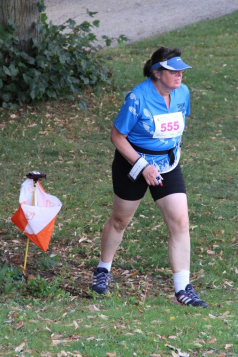
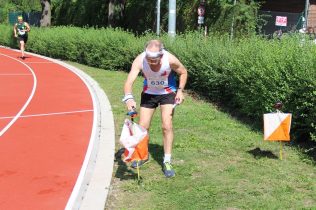
Ian and Ted did battle once again. Ian ran hard and finished in 19 minutes – not quite enough to hold off Ted, who was a minute faster. We were all a happy crew.
Ted and Margi decided to head “home” for a couple of hours R&R, while Ian and I went sightseeing. Our destination was the village of Donaustauf, home to “Walhalla”. This marble monument is high above the river and can be seen for miles. Modelled on the Parthenon and initiated by King Ludwig 1, it opened in 1842. Inside, it houses busts of significant Germanic figures. Outside, it offers lovely views of the Danube. We stood on the top steps, feeling very relieved that we chose not to arrive by boat, which would have been a significant climbing effort.
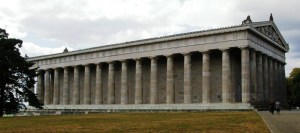
Walhalla
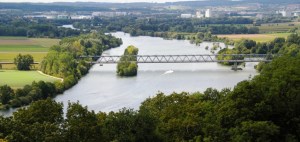
Danube valley

How many steps? We didnt count
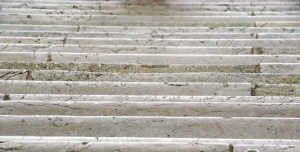
Steps …
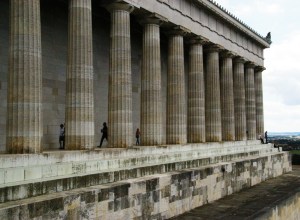
Columns …
Back in town, we crossed the Steinbrucke at a more leisurely pace, and met our guide, Christa, outside the cathedral. She had a nice dry sense of humour and gave just the right amount of information as she led us through streets, lanes and courtyards, pointing out the sights and telling stories. We began with the exterior of Dom St Peter, which employs 10 stone masons full time to carry out repairs. Construction started in the 1200s, but the elaborate spires were a 19th century addition. We could clearly see the different architectural styles which are inevitable when building takes hundreds of years.
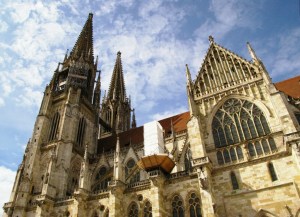
Dom St Peter

Next was the Roman gate and tower, Porta Praetoria. Regensburg, then known as Castra Regina, was established in 179 AD, as a military camp. It was unearthed in 1890. It is thought that the tower was twice its current height. It is the oldest above-ground structure north of the Alps.
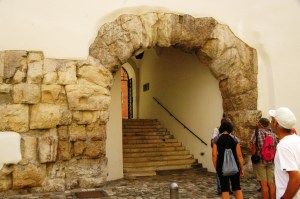
Porta Praetoria

Roman tower
We paused at an ancient sausage kitchen before another look at the bridge. It was built in the 1100s; when stone was very expensive, demonstrating the extreme wealth of Regensburg. The large concrete “pontoons” are ice breakers.
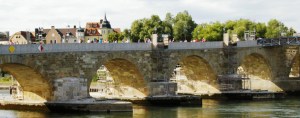
Steinbrucke
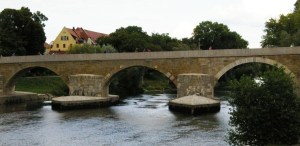

Riverside houses

Next we saw the Goliath House with its huge painted façade, dating from 1573, then on to the Town Hall. This square, with its balcony, elaborately decorated windows, and arches leading into hidden courtyards, was distinctly Venetian. After looking at the Haidplatz, we made our way back to the cathedral to conclude the tour. I loved seeing the different colours and shapes of the buildings and turrets, and the surprises that lay around each corner.
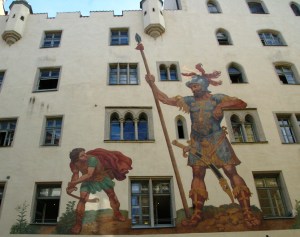
Goliath Haus
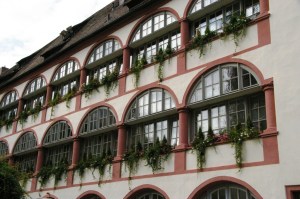
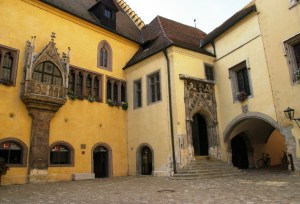 Venice?

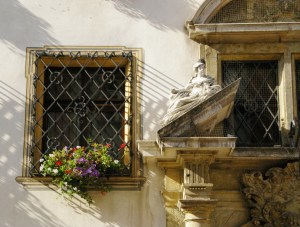

Not lederhosen
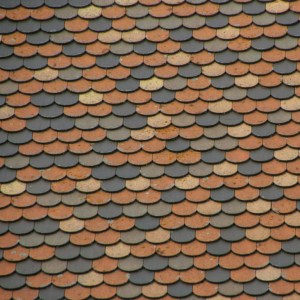
Shingles
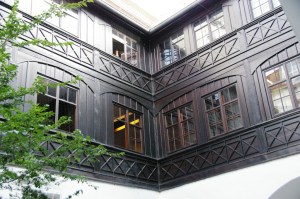
Merchant’s house
We left Regensburg via a tranquil woodland riverside path. All the cities we have visited have made great use of their green spaces – you can always quickly escape the traffic.
It’s our last night in the Schloss. I’m afraid we’ve set the bar high. Time to eat leftovers.
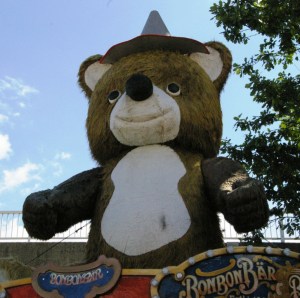
Big Ted
No comment necessary
 dipidydoo
Did “pausing at the sausage kitchen” involve the sampling of the odd wurst or several?
Pete.