It’s amazing what 11 hours solid sleep will do to revive you, followed by a leisurely breakfast, a lazy morning, and a lunch of bacon and fresh farm eggs. You may guess that we were not very energetic this morning. We both needed some time out. My ankle no longer looked like an ostrich egg, so we decided to head out for a drive and spend a couple of hours looking at one of the many Roman sites in this area. Our afternoon destination was Corbridge.
Established after AD160 to replace a series of forts, Corbridge became one of only two substantial towns near Hadrian’s Wall. The town was built on top of the forts, and their remains are mostly invisible, although they explain the subsidence in the centre of the site. In around AD160, Corbridge became a base for legionaries, whose role was to support and help garrison the wall, and to provide a base for stores, repairs and logistics.
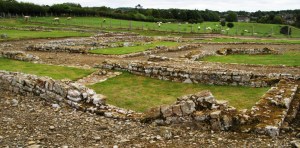
Corbridge Roman Town
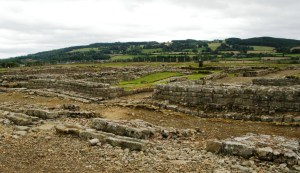
Corbridge was the most northerly town in the Roman empire. Unlike other settlements, it continued to thrive as the Empire started to fall apart, no doubt due to its distance from HQ back in Rome. The Stanegate was a major Roman road than ran from Corbridge to Carlisle, and along with the nearby River Tyne, opened up the town to trade. Soldiers passed through on their way to Hadrian’s Wall, and traders kept them supplied with goods and services. The site consisted of two military compounds, a granary, a warehouse and market area (never completed), a small temple.
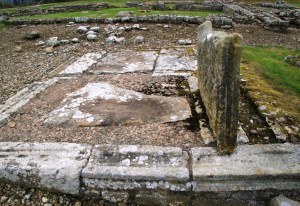
Water trough
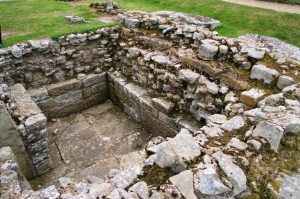
Underground storage chamber; steps still intact
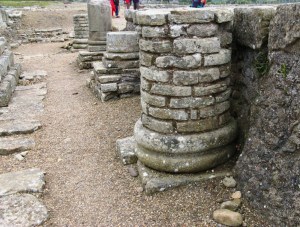
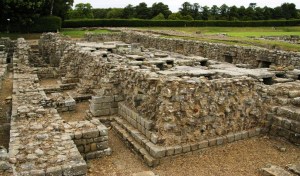
Granary
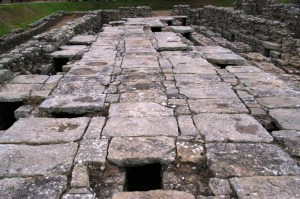
The gaps are to allow air to circulate under the floor
By the early third century, a substantial civilian town had grown up around the site. The town flourished right through the later years of the Roman Empire, but was eventually abandoned after the Romans left Britain. A Saxon settlement was established half a mile east in the 600s, and much of the stone was stolen by the builders of Hexham Abbey.

Roman street with drainage channel

Subsidence due to building on top of rotted timbers from earlier forts
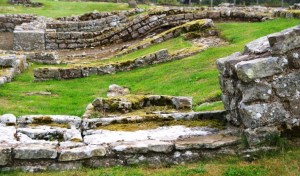
Excavation began in 1906 and continued through most of the 20th century. In 1964, a chest was found, containing military equipment, armour, and tools. This formed the basis of the collection housed in the adjacent museum, along with many other artefacts since dug up by archaeologists.
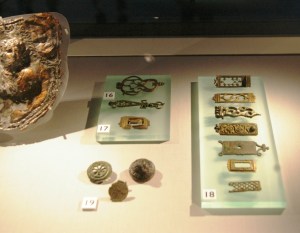
Military belt buckles
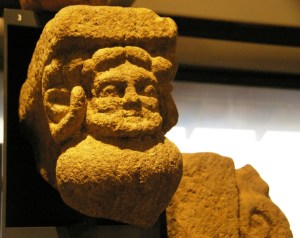
Decorative stonework

Piecing puzzles together

Jars
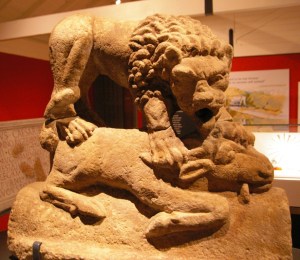
The Corbridge Lion
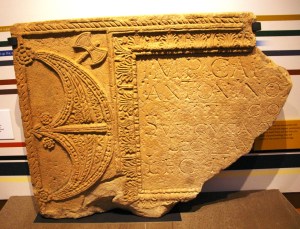
Inscriptions told archaeologists much about the site
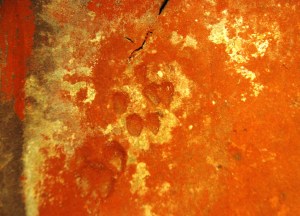
A Roman dog walked across this ceramic roof tile before it had dried (I am not making this up!)
We were lucky enough to join a guided tour, which explained how the archaeologists were able to put together the pieces of the puzzle, and figure out exactly what the site contains. He had a nice sense of humour. What I really liked was that there were no barriers, fences or “keep off” signs – you can wander at will around and over the foundations, and have a really “up close” look. Unfortunately the wind was freezing, so we retreated to the museum, which is an excellent display.
Our final stop was nearby Corbridge, a quintessential town of stone buildings, narrow one way roads, and a famous stone bridge with 7 arches (rather like the one at Richmond in Tasmania). The bridge was built in 1674, and is the only bridge over the Tyne that survived the great flood of 1771. Today it serves as the entrance to the town for vehicles (including double decker buses) and pedestrians. The town could be the backdrop for any one of those British Friday night shows on the ABC.

Typical Northumbian sheep
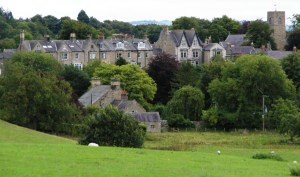
Corbridge
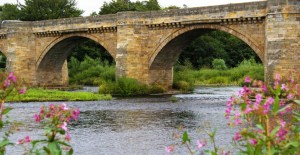
Corbridge’s bridge

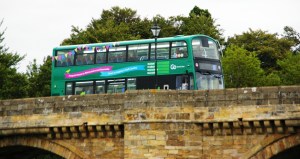
We’re not in Kansas
Speaking of which, after dinner (British sausage – pork and leek – with mash and asparagus tips), Grand Designs is on the telly. Time to put the feet up.
 dipidydoo
Felix qui potuit rerum cognoscere causas.
Virgil.
et sine usura Google
Debbie