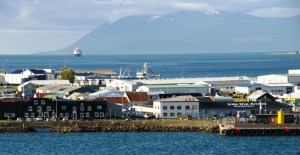
The alarm sounded at 5.30am. A quick glance out of the cabin window showed that we were already inside the Eyjafjordur, one of the longest fjords in Iceland. Unlike yesterday, the sky was heavy with thick cloud, and we did not rush up on deck this time. We had to be in the queue for a tender, in order to meet our tour. There were four cruise ships in the harbour, and only two were able to berth. The captain had made an early announcement that they might not be able to run the tenders due to strong winds, but the weather improved and by 8.15 we were on our way ashore.
We joined our small group of 14, on board a minibus driven by our Hungarian/Icelandic guide for the day. Not only did he tell us about the things we were seeing, but he chatted about Icelandic economics, politics, and way of life; as well as what is was like for a non-native to adapt to a new home. He explained that sheep’s head, including the eye, is a traditional Icelandic dish, but rotted shark, often sold to tourists as “Icelandic”, is not something that the locals eat!
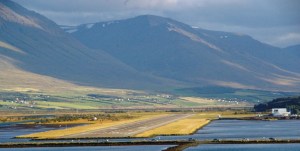
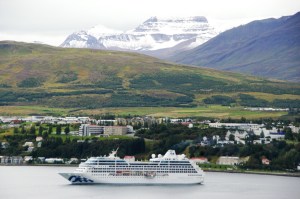
We drove past the airport runway, which sits prominently in the middle of the fjord. Planes were diverted here when the famous volcano erupted in 2010, causing angst for European travellers and newsreaders around the globe. We climbed up to a lookout point, which gave us nice views over Akureyri town, the nearby snow capped peaks, the fjord, and the ships. Our guide told us that four ships at once was a record, and that it had been hard for tour companies to supply enough buses for the day tours. Iceland appears to have recovered nicely from the GFC, thanks to a booming tourism industry and cheap energy.
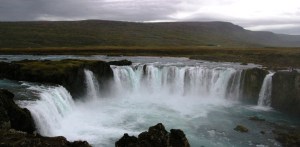
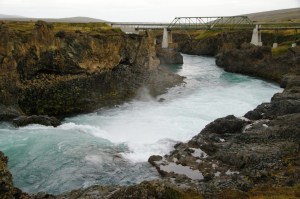
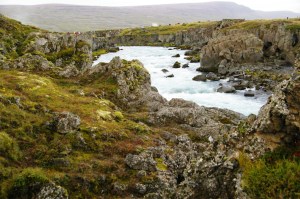
Our own day tour was a circuit of Lake Myvatn, a popular holiday and birdwatching spot in the north of Iceland. The first stop was the beautiful Godafoss waterfall, and we spent a pleasant half hour meandering along the trails either side of the gorge, carved by the glacial flow of the Skjalfandafljot River. The story goes that one of the first Christian missionaries threw all the old Viking statues of their gods into the river, hence the name “Waterfall of the Gods”.


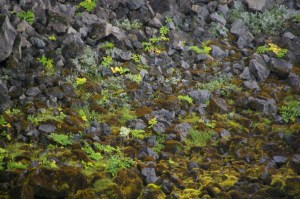
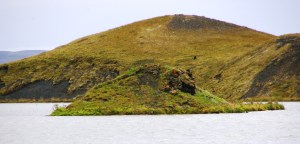
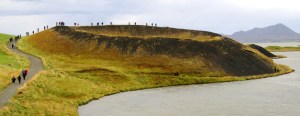
Next was the unique crater landscape of Skutustadagigar, where craters were formed by steam explosions where burning lava met lakes or wetlands. It is one of only two such sites in the world. We only went for a short walk here, but you can walk right around them. We could have spent longer at each place on this tour, but we only had enough time for a taste. It would be a nice area to spend a couple of days.
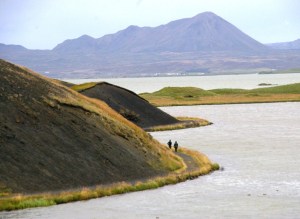

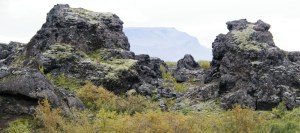
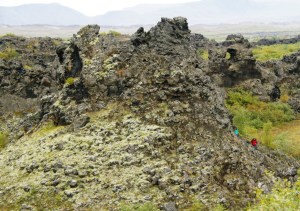
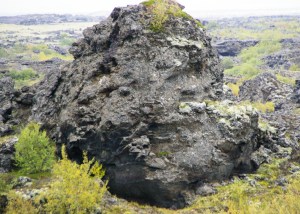
The weird lava landscape of Dimmuborgir was our third stop, and we encountered our first midges (Myvatn being Icelandic for midge). Luckily these little pests don’t bite, but they are an annoyance. We wandered around the tortured lava formations. It was interesting because of the vegetation; most lava fields are just rocks and scree, but this one has quite a lot of greenery, adding splashes of colour to the grey-black. Geologically, Iceland is the youngest country in the world, and the trees here have yet to die off.
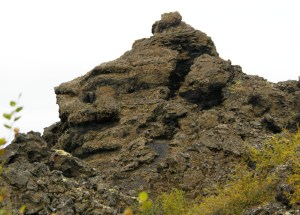
Can you see the lion?
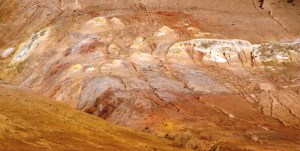
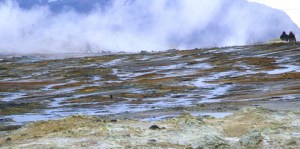
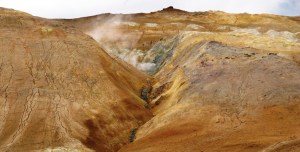
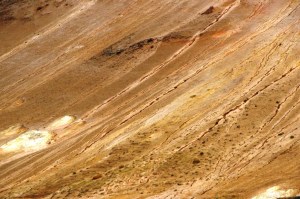
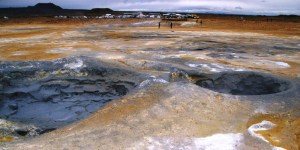
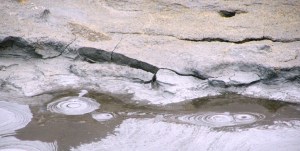
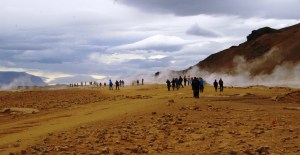
In complete contrast, the nearby Namaskard thermal area, close to a still active volcano, is completely barren. It reeks of sulphur, but is a fascinating little world of mud pools and steam vents, with a dramatic mountain backdrop. The soft greens, golds and charcoal greys of the normal Myvatn landscape changed abruptly to striking reds and oranges. We saw an endurance race in progress here, with competitors kitted out for what looked like long distance. They were racing individually, following small red marker flags.



It was just a short hop from here to our lunch stop, the Myvatn nature baths. Similar to Reyjkavik’s Blue Lagoon, but less crowded and less expensive, we decided to treat ourselves, despite the hefty entrance fee. After all, soaking in natural geothermal springs is an Icelandic tradition, and a lot more pleasant than eating a sheep’s head! The dash from the change room to the pool was challenging, but we slid into milky blue water at just the right temperature, and soon felt completely relaxed. We were surrounded by volcanic rock, with mountains on the horizon, and the sand on the bottom of the pool was black.
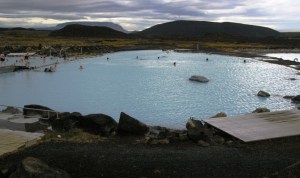
Ahhhh … bliss!
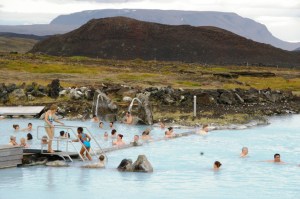
After a blissful soak, we dried, dressed, and returned to the bus. Once back in Akureyri, our guide quickly showed us the historical part of town, then dropped us back at the pier. With our change of sailing plan, we now had plenty of time for a late afternoon stroll on our own. Already we’d noticed how neat and clean Akureryi is, and we wanted to explore a little.
Akureyri began as a Viking settlement, but did not establish itself as a town until the late 1800s, when Norwegian fishermen came. It is not a flat town; there were quite a number of steps up to the stone church which is the prominent structure. Someone had recently sprayed a lot of graffiti on the walls, and someone else had gone to a lot of effort to cover it up. Inside, it had lovely stained glass windows, and a model ship hanging from the ceiling, to protect those at sea.
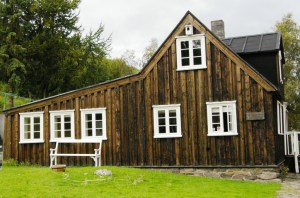

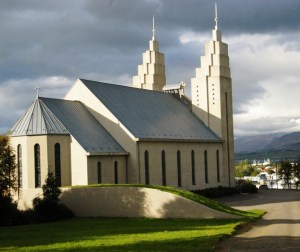
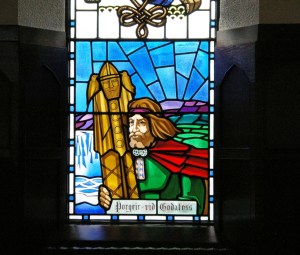
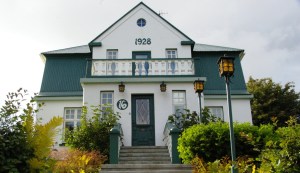
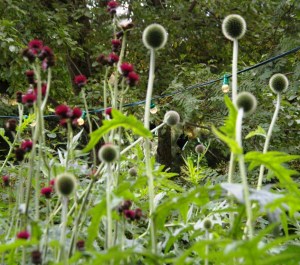
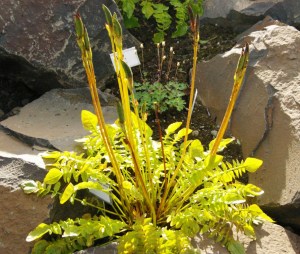
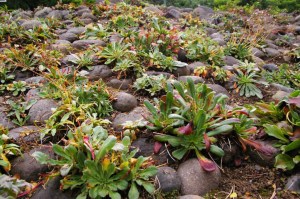
Further up the hill, we passed some gracious houses, which are apparently never up for sale, just passed down through families, such is the demand. We were soon at the Botanical Gardens, which feature thousands of plants from around the world, as well as a sample of every Icelandic species. Set on the hillside, it was a lovely place to wander around for a while. Even the sun emerged briefly, and we saw a rainbow over the water.
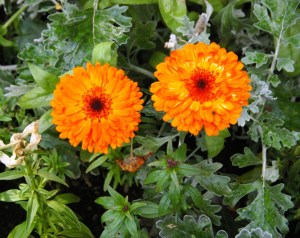
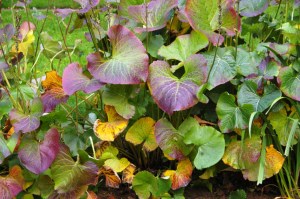
We made our way back to the pier via the small shopping street, which was mostly restaurants, and an outdoor gear shop called 66 North. Overnight, we’d crossed the Arctic Circle, but Akureyri lies just below it. Ian thought a souvenir from there might be fun, but the prices were prohibitive – in face most things are double the price at home. Petrol is $3 a litre, and a pizza is about $40. We decided to keep our credit cards in our wallets.
Back on board ship, we enjoyed our now customary evening fjord views from Deck 11, and played a little pre-dinner shuffleboard. We indulged in sweetcorn and potato chowder, followed by duck a l’orange, and french vanilla souffle. The evening was rounded out with a lovely violin and piano concert, then we watched the twinkling lights of the town from our cabin window; the captain having conveniently turned the ship to face the right direction.
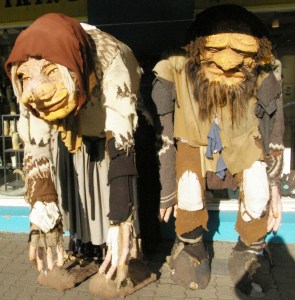
Debbie and Ian after a hard day’s sightseeing
At Sea update: we are currently sailing around the northwestern part of the Icelandic coast, and have had views of dramatic, if misty, peaks. The wind has picked up again so all outside decks are closed, and no-one moves around unnecessarily. At 2pm, we re-crossed the Arctic Circle, before turning south and heading for Reyjkavik, bypassing Grundafjordur. Just as well, as in this weather, no-one would have bothered leaving the ship anyway. We are told that the wind will abate overnight, and hopefully things will calm down from then on. It’s not rough by any means, just disconcerting and a bit uncomfortable at times, though the motion rocks us to sleep.
This morning the ship had a definite list, because of the wind, and they had to redistribute weight to even things up. I think we’d like our next cruise to be in the Mediterranean! We really can’t complain, as the weather has generally been in our favour, with the worst of it on sailing days. On port days, we just rug up in thermals and down jackets, and we’re fine. We’ve had almost no rain to speak of.
Trivia update: Our team name, Mixed Bag, represents our mixture of nationalities (2 Aussies, 2 Brits, and 2 Americans) and specialty subjects, and we have become the ones to beat. We’ve won drink coasters, notebooks, water bottles and carry bags. I think we are on the verge of being banned …
Fun fact no 1: knitting is the national pastime of Iceland. Well, you have to do something when there’s no sun for four months of the year.
Fun fact no 2: Akureyri is home to the world’s most northern 18 hole golf course.
 dipidydoo
Have you learned to pronounce the name of the volcano Eyjafjallajokull?
Pete.
Did you play golf for me at Akureyri?
Ian
We tried but the balls kept disappearing into volcanic craters